A Day in the Studio: Life as a Crochet Maker
An honest look at a day in the Crochelly studio, from quiet morning stitches to design work, photography, packing, and administration.
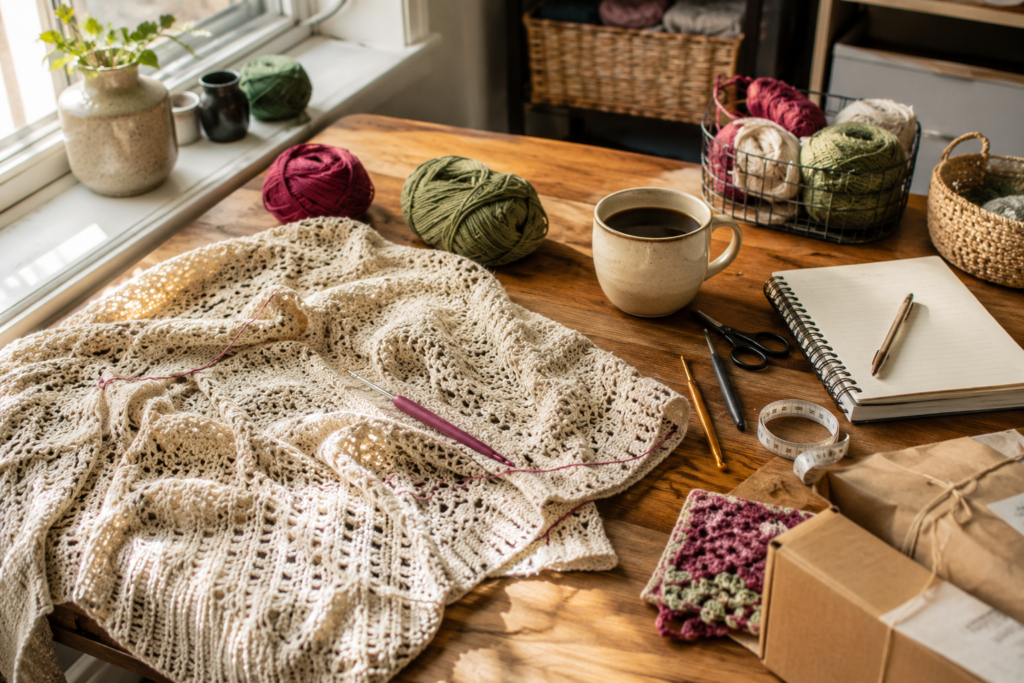
People who follow makers on social media see the beautiful parts — the finished pieces arranged on clean surfaces, the neat skein of new yarn, the satisfying final stitch. What they do not see is the full picture of what a making day actually involves: the administrative hours, the frogged rows, the yarn ends that multiply endlessly, and the unglamorous logistics of running a handmade business.
This post is an honest account of what a day in the Crochelly studio actually looks like — because the reality of this work is interesting precisely because it is not all beautiful.
A Typical Studio Day
Coffee, Light, and Quiet
The studio day starts before the hook is picked up. Coffee first — always. Then natural light if the weather allows it, or the daylight lamp if it does not. These first 30 minutes are for reviewing the day’s plan: what is being made, where each project is, what needs to be finished and what needs to be started.
The Morning Making Block
The first making block of the day is the most productive. Hands are fresh, concentration is high, and the work is closest to its best. Complex techniques — intricate stitch patterns, shaping, colourwork — are saved for this window. I work for two to three hours, often straight through, in near silence or with a podcast or audiobook in the background.
Orders, Messages, and Planning
Mid-morning is for the parts of running a business that have nothing to do with a hook. Checking and responding to every message personally. Processing any new orders. Updating the shop. Planning the production schedule for the week ahead. This work is less romantic than making — but it is equally important, and I give it proper time rather than squeezing it into margins.
A Proper Lunch and Rest
This is non-negotiable and has been since an early lesson about hand health. Repetitive strain is a real risk in handmade production work. Lunch is a genuine break — away from the work, away from the screen. Hands rest. Eyes rest. The afternoon is better for it every time.
Afternoon Making — Finishing Work
The afternoon making block is for finishing work — weaving in ends, blocking, seaming, quality checking. These tasks require care and patience but less of the precise concentration that complex stitch patterns demand. This is also when I work on simpler, repetitive sections of ongoing projects — the long stretches of stockinette on a sleeve, the straight rows of a blanket border.
Product Photography
Finished, blocked pieces are photographed in the best natural light of the day. This is more involved than it looks — finding the right surface, the right light angle, the right styling. A single product requires 20 to 30 images to produce 6 to 8 usable shots. Getting this right matters because the photograph is the first thing a potential customer sees — and it has to communicate the texture and quality that can only truly be felt in person.
Order Packaging
Orders are packed with the same attention as the making. Each piece is folded carefully, wrapped, and packaged with a handwritten note and care instructions. Packaging that reflects the quality of what is inside it. Nothing goes out in a bag that undermines the experience of receiving it.
End-of-Day Review
The studio day ends with a brief review of what was accomplished, what is in progress, and what tomorrow’s priority is. Then the hook goes down. This boundary between work and non-work is important — not always easy to maintain, but always worth maintaining.
The Studio Space
The physical space where making happens matters more than people realise. Good light, good ergonomics, and a space that is organised enough to be functional without being so tidy it becomes a performance — these things affect the quality of the work directly.
The Lighting Setup
Natural light from a north-facing window for morning work. A professional daylight LED lamp for afternoon and winter months. Good light is not optional — it is what allows you to see stitch placement accurately and catch errors before they compound.
- North-facing window — consistent, diffuse light
- Daylight LED at 5500K colour temperature
- No overhead fluorescent lighting
Yarn Storage
Yarn is stored by fibre type and weight, not by colour — because the making decision starts with material properties, not aesthetics. Open shelving keeps everything visible. Nothing is stored in sealed containers that would prevent the fibres from breathing.
- Open shelving — always visible, always accessible
- Organised by fibre type first, weight second
- Cedar blocks to protect natural fibres from moths
The Making Chair
An ergonomic chair that supports the lower back during long sitting sessions. The single most important physical investment in the studio. Posture during crochet is not talked about enough — after several hours, the difference between good and poor support is significant.
- Full lumbar support — non-negotiable
- Adjustable armrests to support forearms
- Positioned to face the light source
Pattern and Design Station
A dedicated area for sketching, pattern development, and gauge testing. Graph paper, coloured pencils, and a collection of reference materials. Design work happens here before a single stitch is crocheted — and often continues here between making sessions as the piece evolves.
- Graph paper for stitch diagrams
- A reference library of stitch dictionaries
- Swatches pinned for ongoing reference
Blocking Station
A dedicated area of the floor covered with interlocking foam mats, always set up and ready. Blocking is the last step of every piece and it requires space — a piece that cannot be laid completely flat cannot be blocked properly. This space is treated as permanent, not occasional.
- 12 interlocking foam mats — 48 square feet total
- T-pins always pre-loaded in a foam block
- Blocking wires in graduated lengths
Packaging Area
A clean, dedicated surface for packaging orders. Pre-folded tissue paper, printed care cards, handwritten note cards, and outer packaging all stored here, ready. The packaging process has a ritual quality to it — each order is packed with the same attention as the making itself.
- Tissue paper in two neutral colours
- Printed care instruction cards
- Handwritten note cards for every order
The Tools I Use Every Day
Clover Amour Hooks
Ergonomic soft-grip handles in every size. Reduced hand fatigue during long sessions.
⭐ Daily Favourite
Tape Measure
A flexible 60-inch tape measure that lives in my hook case at all times. Used constantly.
Clover T-Pins
Stainless steel rust-proof T-pins for blocking. 200 pins — I use every one of them.
⭐ Essential
Chibi Yarn Needles
Bent-tip tapestry needles that make weaving in ends on thick yarn dramatically easier.
Stitch Markers
Locking plastic markers in multiple colours. I use colour-coding for different types of markers.
⭐ Always in Use
Havel’s Snips
Small, precise scissors that cut cleanly close to the fabric without catching or fraying.
Row Counter App
Digital row counting eliminates the single most common source of errors in pattern following.
Spray Bottle
For light spray blocking and misting pieces between wet blocks. Always within reach.
Eucalan Wool Wash
No-rinse fibre wash used in every wet blocking soak. Conditions and protects natural fibres.
⭐ Daily Favourite
The unglamorous truth of making is that most of the hours look nothing like the photographs. Most of the hours look like someone sitting quietly with a hook and some yarn, paying close attention. That is the work. And I love it.
See the Pieces These Hours Create
Every hour in the studio produces something real. Browse the collection that these days build.