Re-Blocking After Washing: Maintaining That Perfect Finish Long-Term
Learn when and how to re-block crochet after washing so garments, shawls, and home pieces keep their intended shape and finish.
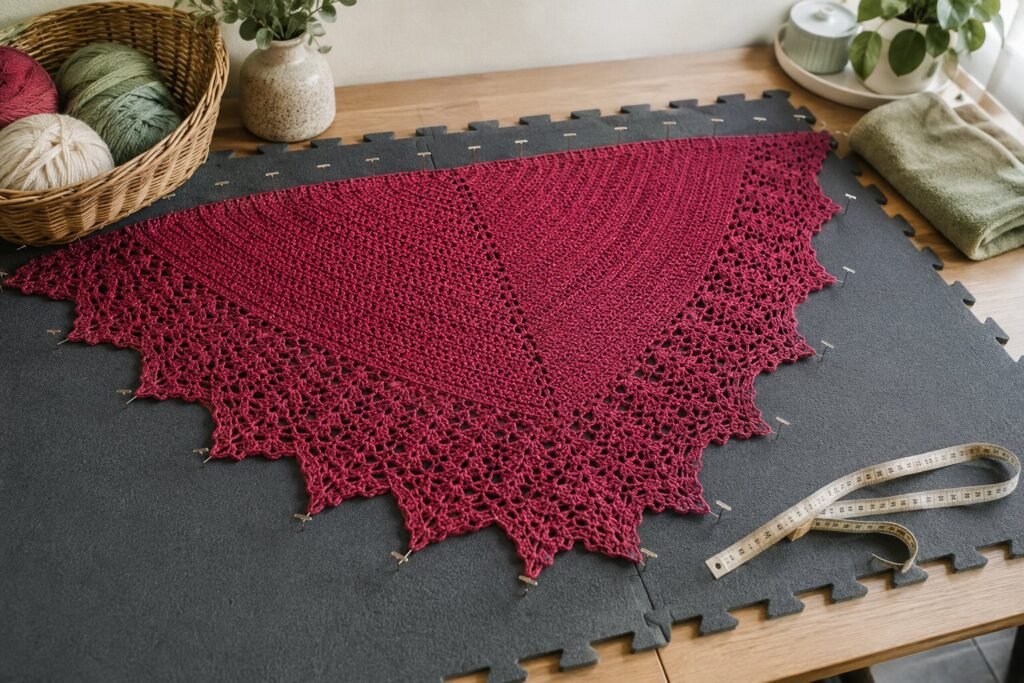
Every Crochelly piece is blocked before it leaves the studio. You know this if you have read our other blog posts — blocking is the finishing step that sets correct dimensions, evens the stitches, straightens the edges, and gives the piece that professional, intentional appearance that separates handmade craft from handmade excellence.
What many people do not know is that blocking is not a one-time event. It is a maintenance practice. Natural fibre crochet pieces need to be re-blocked after washing to maintain their shape, their dimensions, and the quality of their finish over time.
This post explains what re-blocking is, when it is needed, how to do it efficiently, and how to make it a seamless part of your care routine rather than a complicated additional task.
Why Does Blocking Wear Off After Washing?
Blocking works by using water to relax the fibres of the yarn and then drying them in a specific shape. The fibres hold that shape because they have been dried under gentle tension. They will hold it indefinitely — until they are wetted again.
When you wash a piece, the fibres relax back into their natural state. Without re-blocking, the piece will dry in whatever shape it happened to be in — which is rarely the correct one. Lace holes close slightly. Edges curl. The precise dimensions shift by centimetres. The overall appearance loses the crispness that blocking created.
Re-blocking is not extra work. It is part of the washing process — the final step that completes the wash rather than a separate task that comes after it. Once you understand it this way, it becomes automatic.
Does Every Piece Need Re-Blocking After Every Wash?
Always Re-Block These
- 🧣 Lace shawls and wraps — lace holes close without re-blocking
- 👕 Garments — sweaters, cardigans — to maintain fit and shape
- 🔷 Joined motifs and granny square items — to keep joins flat
- 🏠 Decorative home pieces — table runners, placemats
- 🎀 Anything with decorative points, scallops, or shaped edges
- 🌿 Any natural fibre piece where shape and dimensions matter
Re-Block Occasionally
- 🧤 Hats and beanies — shape is maintained by structure
- 🧺 Bags and totes — structure maintained by use
- 🛏️ Chunky blankets — may need occasional re-blocking for edges
- 🧶 Simple scarves in non-lace patterns — if edges curl
- 👶 Baby items — as needed when they lose their soft shape
- 🏡 Storage baskets — if they lose their circular or rectangular form
How to Re-Block: The Complete Process
Re-blocking uses exactly the same process as initial blocking — the difference is simply that you already know the correct dimensions and the piece already has the memory of its correct shape. Re-blocking is almost always faster than initial blocking for this reason.
Wash the Piece First
Re-blocking is done as part of the washing process — not separately. Wash the piece using the appropriate method for its fibre type (see Post 1 of this series), and proceed to blocking while the piece is still damp from washing. Do not let it dry between washing and blocking.
Press Out Excess Water
After washing and rinsing, press out excess water using the towel rolling method — never wring or twist. The piece should be damp throughout but not dripping. Too much water makes the fibres very heavy and difficult to pin accurately; too little means the fibres will not relax enough to take the blocked shape.
Refer to the Original Dimensions
Use your care instruction card — which includes the finished dimensions of your Crochelly piece — as your blocking guide. If you do not have this information, measure the piece the first time you block it and note the correct dimensions somewhere you will remember. A sticky note on the care card works perfectly.
Pin to Correct Dimensions
Lay the piece flat on your blocking mat and pin systematically — anchor points first (centre back, corners, key measurement points), then fill in along the edges. Use rust-proof T-pins and place them generously — every half inch along edges that need to be straight, every inch along curved edges. Measure at multiple points to confirm accuracy.
Re-Blocking Goes Faster Each Time
The more times a piece has been blocked, the more readily the fibres return to the correct shape. An experienced piece — one that has been re-blocked ten or fifteen times — practically pins itself. The fibres have been trained into their correct position through repeated blocking and return there with minimal coaxing.
Dry Completely Before Removing Pins
Allow to dry completely — patience is required here. Removing pins before the piece is fully dry will cause it to lose its blocked shape as it finishes drying. For most pieces, 24 hours is sufficient. For bulky pieces or in high humidity conditions, allow 36 to 48 hours. A fan directed at the piece speeds drying without causing any damage.
Remove Pins and Inspect
Remove pins starting from the centre and working outward. The piece should hold its shape completely — if any areas have pulled back toward an unblocked shape, those areas were either not pinned firmly enough or not fully dry when the pins were removed. A light misting and re-pinning of those sections will correct this.
How Often to Re-Block: A Fibre-by-Fibre Guide
Wool & Merino
Every Wash
Wool relaxes completely when wet and needs re-setting each time
Alpaca
Every Wash
Alpaca is heavy and prone to stretching — consistent re-blocking essential
Cotton
Every 2–3 Washes
Cotton holds its shape better than wool between washes
Linen
Every 2–3 Washes
Linen becomes more dimensionally stable with age and use
Bamboo
Every 2 Washes
High drape fibres benefit from regular re-blocking to maintain shape
Acrylic
As Needed
Acrylic holds its blocked shape well between washes — re-block when edges curl
Quick Re-Blocking: When You Need to Refresh Between Washes
Sometimes a piece needs a light refresh — not a full wash, just a restoration of its shape after wearing. This is particularly common for shawls and lace pieces that get slightly crumpled in a bag, or sweaters that develop a slightly misshapen appearance after several wears.
The 10-Minute Spray Re-Block
Pin the piece to your blocking mat in the correct shape. Using a clean spray bottle filled with cool water, mist the piece evenly until the fibres are damp but not soaking. Pat gently to distribute the moisture. Allow to dry completely on the mat. This quick spray re-block takes 10 minutes of active time and refreshes the piece beautifully — no washing required.
The Steam Refresh
For quick shaping without water, a handheld garment steamer held 2 to 3 inches from the surface can relax fibres enough to allow reshaping. Pin the piece first, then steam, then allow to cool and set completely before removing pins. This is particularly effective for wool and wool blends. Always test on a small inconspicuous area first.
The Long-Term Result: A Piece That Ages Beautifully
A handmade crochet piece that is correctly washed and re-blocked after every wash does not age in the conventional sense. It does not deteriorate. It does not lose its shape or its professional finish. If anything, it improves — natural fibres soften and develop character with use, the stitch work settles, and the piece becomes better adapted to its owner’s body and life.
Consistent Care from Day One
The first wash is the most important. Establish the re-blocking habit immediately and it becomes a seamless part of your laundry routine rather than a special effort.
Keep Your Dimensions Reference
Store the care instructions and finished dimensions with the piece or in a digital note. Having the correct measurements always available makes re-blocking precise and quick.
Address Changes Promptly
If a piece has changed shape — stretched, distorted, or developed curling edges — re-block it immediately rather than waiting. The longer an unwanted shape is worn or stored, the harder it is to correct.
Invest in the Right Equipment
Foam blocking mats, rust-proof T-pins, and blocking wires make the re-blocking process significantly faster and the results significantly better. This equipment, purchased once, lasts indefinitely.
Trust the Process
A piece that looks slightly misshapen after washing can look perfect after re-blocking. Do not judge a freshly washed crochet piece before it has been re-blocked. The transformation, even after the fifth or tenth time, is still satisfying.
The 10-Year Mindset
Every time you wash and re-block a Crochelly piece correctly, you are extending its beautiful life by another season. The goal is a piece that looks as good in ten years as it does today. Correct care makes this possible.
Care Is the Final Act of Making
We think of the care instructions we include with every Crochelly piece as the final act of the making process — instructions that carry the intention of the studio into the home of the person who receives the piece. When you wash and re-block a Crochelly piece correctly, you are continuing the work we started when we made it.
You are choosing to keep something beautiful. You are choosing the slow, considered approach over the disposable one. You are exercising the same care in maintaining the piece that we exercised in making it.
That continuation — from maker to owner — is what turns a purchase into a piece that lasts a lifetime.
Share Your Re-Blocking Moments
We love seeing our pieces pinned out and being cared for. Tag us in your blocking photos — before, during, or after. Every one is a celebration of a piece being treated the way it deserves.
Invest in a Piece Worth Caring For
Every Crochelly piece is made to be maintained — to last years of correct washing and re-blocking and emerge more beautiful each time.