Sustainable Fashion: Why Crochet Is the Ultimate Slow Fashion
Explore how handmade crochet supports slower wardrobes through skilled craftsmanship, natural fibers, durability, repairability, and meaningful design.
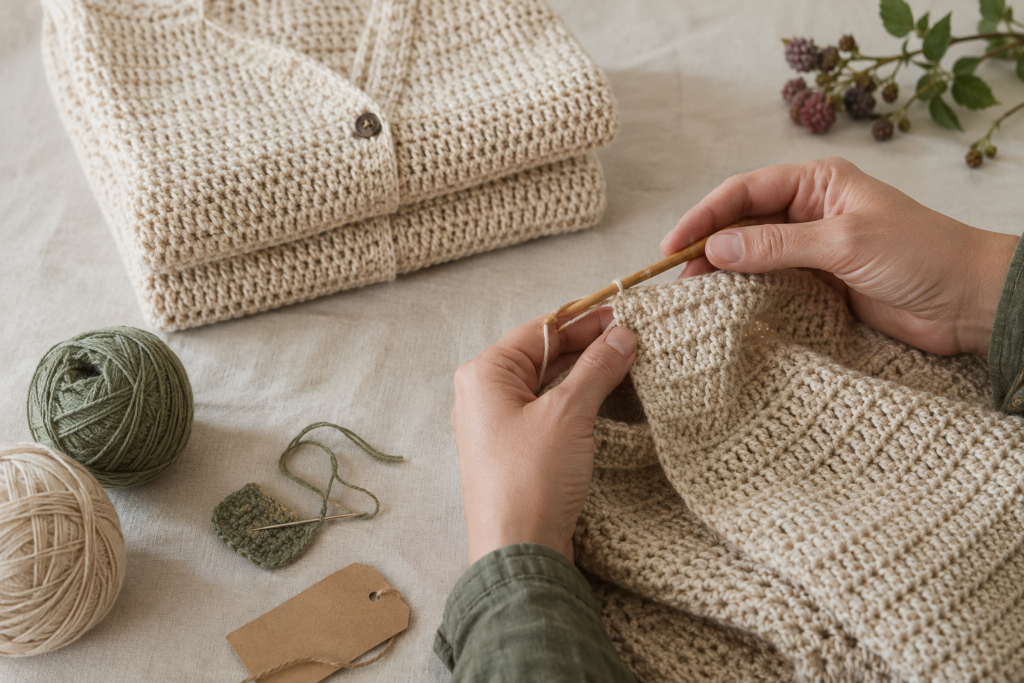
Every year, the fashion industry produces over 100 billion garments. The majority of those garments will be worn fewer than five times before being discarded — ending up in landfill, releasing microplastics into waterways, or contributing to the vast carbon footprint of clothing production and transportation.
There is a different way to dress. It is slower. It is more intentional. And it produces garments that are not only better for the planet — but better for you in every measurable way.
It is called slow fashion. And crochet is one of its most powerful expressions.
Fast Fashion vs Slow Fashion: What Is the Actual Difference?
The distinction between fast fashion and slow fashion goes far beyond how quickly a garment was made. It touches every part of the supply chain — from raw material sourcing to the end of the garment’s life.
❌ Fast Fashion
- ✗Designed to be discarded after one season
- ✗Made in factories with poor labour standards
- ✗Synthetic fibres that shed microplastics
- ✗Dyes and treatments that pollute waterways
- ✗No visible supply chain or transparency
- ✗Worn fewer than 5 times on average
- ✗No story, no meaning, no emotional connection
- ✗Ends up in landfill within months
✓ Slow Fashion / Crochet
- ✓Designed and made to last for decades
- ✓Made by skilled artisans paid fairly for their work
- ✓Natural fibres that biodegrade safely
- ✓Minimal processing and chemical treatment
- ✓Complete transparency — you can see who made it
- ✓Kept, worn, and cherished for years
- ✓Every piece carries a story and intention
- ✓Can be repaired, altered, and passed on
Why Crochet Specifically Is Slow Fashion at Its Purest
Not all slow fashion is created with a hook. But crochet has qualities that make it particularly aligned with the values of sustainable, conscious dressing — qualities that go beyond just the environmental footprint of the materials used.
A crochet garment cannot be rushed. Every stitch is placed individually, by hand, with intention. That slowness is not a limitation — it is the point. It is what gives the finished piece its value.
1. One Person, One Tool, One Piece
A factory producing fast fashion runs thousands of machines simultaneously, consuming enormous amounts of energy, producing waste at every stage, and employing workers in conditions that are rarely made visible to the consumer. A crochet piece is made by a single person with a single hook. The energy used is human energy. The waste is almost zero. The maker is visible and accountable.
2. Natural Fibres Are Inherently Sustainable
The yarn fibres used in quality crochet — wool, alpaca, organic cotton, linen, bamboo — are natural, renewable, and biodegradable. At the end of a handmade piece’s long life, it can return to the earth without leaving microplastics behind. A synthetic fast-fashion garment will take hundreds of years to decompose, shedding harmful particles throughout that entire time.
3. Repairability and Longevity
A fast-fashion garment that develops a hole is a garment that gets discarded. A crochet piece that develops a hole can be repaired — by the original maker, by the owner, or by any skilled crocheter. The structure of crochet makes individual stitches accessible and repairable in a way that machine-made fabric simply is not. This repairability dramatically extends the lifespan of handmade pieces.
4. Emotional Durability
Research consistently shows that we keep and care for things we have an emotional connection to. A garment with a story — made by hand, by a specific person, with intention — creates an emotional connection that mass-produced clothing cannot. People keep their Crochelly pieces. They care for them. They pass them on. That emotional durability is an environmental good in itself.
5. Supporting a Living Economy, Not an Exploitative One
When you purchase a handmade piece, you are paying the actual cost of skilled human labour. That money goes directly to the maker — not to a distant corporate supply chain. You are supporting a living economy built on craft, skill, and human connection rather than the extraction of cheap labour from vulnerable populations.
Common Myths About Sustainable Fashion
“Sustainable fashion is too expensive for most people.”
The true cost comparison: a $15 fast-fashion top purchased four times a year costs $60 annually and likely ends up in landfill within 12 months. A $120 handmade piece purchased once, worn hundreds of times, and kept for a decade costs $12 per year. Slow fashion is not more expensive — it only appears to be when you measure cost per purchase rather than cost per wear.
“One person’s choices don’t make a difference.”
Every industry is driven by consumer demand. Fashion designers produce what sells. Factories manufacture what is ordered. When enough consumers shift their purchasing toward slow, handmade, and sustainable, the entire industry responds. Your individual purchase is a vote — for the kind of fashion industry you want to exist.
“Handmade means lower quality or unfashionable.”
The handmade pieces that appear on the runways of Bottega Veneta, Chanel, and Loewe are handmade because handmade is the highest quality. Machine production is a cost-cutting measure — not a quality one. A skilled crocheter produces work that no machine can replicate, with a level of individual attention and quality control that mass production cannot achieve at any price.
How to Transition to a Slower Wardrobe
You do not need to overhaul your entire wardrobe overnight. Transitioning to slow fashion is itself a slow process — intentional, considered, and personal.
The 30-Wears Rule
Before purchasing any new garment, ask yourself: will I wear this at least 30 times? If the answer is yes, the purchase is justified. If the answer is uncertain, wait. This single question dramatically reduces impulse purchases and naturally directs spending toward quality, versatile pieces — exactly what handmade crochet produces.
What Crochelly’s Commitment to Slow Fashion Looks Like
We source natural, sustainably produced fibres wherever possible. We pay fair rates for every hour of skilled handwork. We do not manufacture in bulk or hold excess inventory. Every piece is made to order or in small batches — which means nothing we make goes to waste.
We also tell you exactly what went into every piece: the fibre, the maker, the technique, the care required. Because transparency is not optional in slow fashion. It is the whole point.
Start Your Slow Wardrobe with Crochelly
Each piece is a considered investment in quality, craft, and sustainability.