Storing Your Crochet Collection the Right Way
Store crochet sweaters, blankets, and accessories correctly to prevent stretching, moisture damage, pests, and fading.
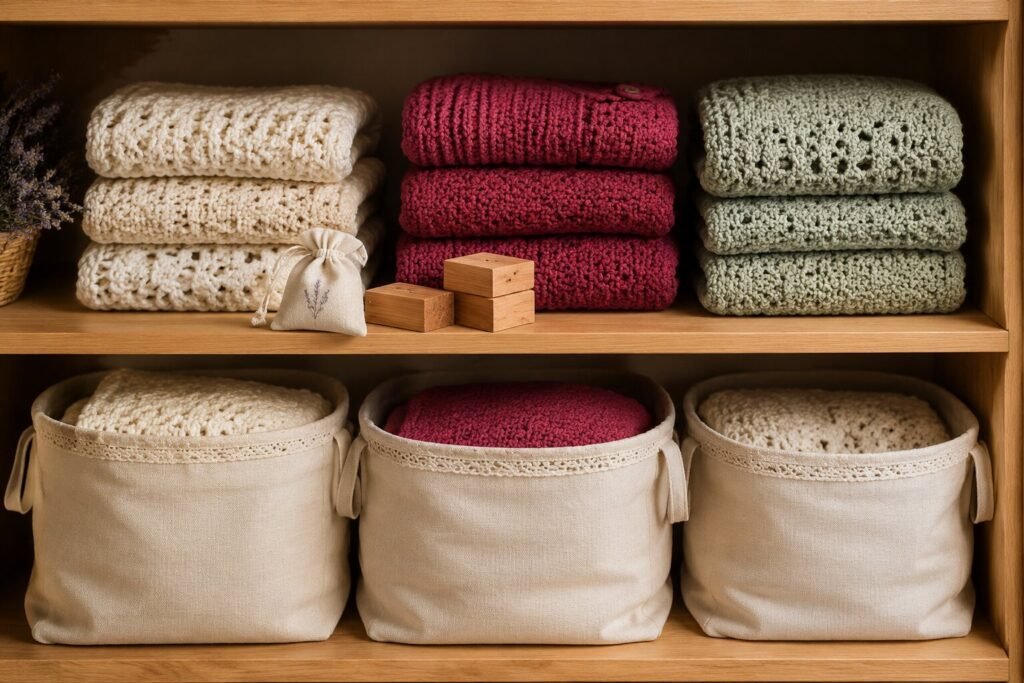
The care you give a handmade crochet piece does not end when you put it away. Storage is an active part of the care process — and done incorrectly, it can cause damage that no amount of washing or repair can fully undo. Stretched shoulders from hanging. Moth damage from inadequate protection. Mildew from storing pieces that were not completely dry. Colour transfer from folding with incompatible fabrics.
This guide covers everything you need to know about storing your crochet pieces correctly — between seasons, between wears, and for long-term preservation.
The First Rule: Never Hang Crochet
Crochet is a fabric of loops — and loops respond to gravity. Any crochet piece stored on a hanger will, over time, stretch in the direction that gravity pulls it. For a sweater, that means a stretched neck, dropped shoulders, and a distorted silhouette that cannot be fully recovered.
✓ Always Fold
The Correct Method for All Crochet
- ✓Maintains the natural shape of the piece without gravitational distortion
- ✓Prevents shoulder and neckline stretching
- ✓Allows air circulation around the fibres
- ✓Correct for all fibre types — wool, alpaca, cotton, and blends
- ✓Reduces friction on the surface which causes pilling
- ✓Works for garments, blankets, and accessories of all sizes
✗ Never Hang
Causes Irreversible Damage Over Time
- ✗Gravity stretches the fabric continuously in one direction
- ✗Shoulders and necklines distort and cannot fully recover
- ✗The weight of the piece concentrates on a narrow hanger edge
- ✗Particularly damaging for heavy pieces — blankets, chunky cardigans
- ✗Even velvet hangers cause distortion over time
- ✗Fine lace pieces stored on hangers develop permanent creases at the hanger points
How to Fold Crochet Correctly
The goal when folding is to distribute the piece evenly so no single area bears all the weight and tension. Different pieces require slightly different approaches:
Folding a Cardigan or Sweater
Fold the sleeves back across the body first, then fold the piece in thirds or in half depending on the drawer or shelf size. The fold line should not fall across buttons or decorative elements — adjust the fold to place the crease in a plain area of the fabric. Alternate the fold direction each time you store the piece to prevent permanent creasing at the same point.
Folding a Shawl or Wrap
Fold in half first along the centre line, then roll loosely rather than folding flat. A rolled shawl takes up less space and avoids the sharp fold creases that are difficult to remove from lace. Store the roll upright in a drawer or basket so air can circulate around it.
Folding a Blanket or Throw
Fold in thirds lengthwise, then fold in thirds widthwise — creating a compact rectangle. For very large blankets, rolling rather than folding is an option and creates fewer fold lines. Store in a breathable cotton bag or a large open basket rather than in a sealed plastic container.
Seasonal Storage: Transitioning Your Collection
Storing Winter Pieces for Summer
- Wash every piece before storing — never store anything worn or soiled
- Allow to dry completely — a minimum of 48 hours — before folding
- Inspect for damage, pilling, or loose ends — repair anything before storing
- Add cedar blocks or dried lavender to the storage area — do not place directly on the yarn
- Store in breathable cotton bags or acid-free tissue — never plastic
- Store in a cool, dark, dry location — never in direct sunlight or near heating elements
- Label storage bags with contents so you know what you have without unfolding
Bringing Winter Pieces Back Out
- Remove from storage and unfold to check the condition before wearing
- Inspect for moth damage, mildew smell, or stored creases
- Air the piece flat for 24 hours before wearing to allow fibres to fully relax
- A light steam or spray block will refresh creases and restore the blocked shape
- Address any pilling with a fabric shaver before the first wear of the season
- Check that all ends are still secure and buttons or closures still intact
Protecting Against Moths: The Complete Guide
Clothes moths are the single greatest threat to stored natural fibre crochet. They are attracted to wool, alpaca, cashmere, and other protein fibres and can cause significant damage in a remarkably short time. The good news is that moth damage is almost entirely preventable with the right precautions.
Cedar Blocks and Rings
Natural cedar wood repels moths through its aromatic oils. Hang cedar rings or place cedar blocks in your storage areas. Replace or sand lightly every season to refresh the scent as the oils dissipate.
Effectiveness: High when refreshed regularly
Dried Lavender
Sachets of dried lavender placed in storage areas and drawers repel moths naturally. Replace every 3 to 4 months as the scent fades. Never place directly on yarn — essential oils can stain.
Effectiveness: Good as a supplementary measure
Freezing Treatment
If you suspect moth activity, seal the affected piece in a plastic bag and place in the freezer for 72 hours at -18°C or below. This kills larvae and eggs without damaging natural fibres.
Effectiveness: Kills 100% of larvae and eggs
Regular Cleaning and Inspection
Moths prefer dark, undisturbed areas. Regularly airing stored pieces, vacuuming storage areas, and inspecting for early signs of damage is the most reliable long-term prevention strategy.
Effectiveness: Excellent when done consistently
Airtight Storage Containers
Truly airtight storage containers prevent moths from reaching fibres entirely. Use with cedar or lavender inside. Note: natural fibres need some air circulation — use breathable containers rather than sealed plastic bags for long-term storage.
Effectiveness: Very good for seasonal storage
Wash Before Storing
Moths are particularly attracted to soiled fibres — body oils, food particles, and sweat provide additional nutrients. Always wash pieces thoroughly before long-term storage. A clean piece is a much less attractive target.
Effectiveness: Significant preventive measure
The Investment Mindset
Storing handmade crochet pieces correctly is an extension of the investment you made when you acquired them. A piece that is stored carelessly — hung, damp, or without moth protection — will deteriorate. A piece that is stored properly emerges each season looking exactly as it did when it went in.
The ten minutes it takes to wash, dry, inspect, and correctly store a piece at the end of each season is the simplest and most effective care you can give it. Do it every time. Without exception.